
Uncategorized
Do you really have one shoe size? Why one shoe can start slipping at the heel
Aug
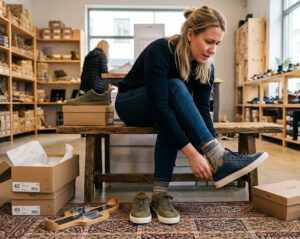
‘I’ve always been a size 8.’
We often say this as if our shoe size were as fixed as our height or eye colour. In reality, it is not quite that simple.
You might wear a size 8 in one pair of shoes and need a size 9 in another. Your two feet do not necessarily have to be exactly the same size either. This may explain why one shoe fits beautifully while the other feels odd or starts slipping at the heel.
It is often only when you begin wearing the shoes properly that you notice it. They felt fine in the shop, but during a longer walk one heel begins moving up and down. What has actually happened?
The number inside the shoe does not tell the whole story
Two shoes marked with the same size do not necessarily have the same fit.
Shoes are made around a form called a last. This influences not only the shoe’s length, but also its width, heel shape, toe room and the amount of space over the foot.
That is why a size 8 from one brand may feel roomy while the same size from another feels tight. The fit can even vary between different styles from the same manufacturer.
This becomes particularly noticeable when buying shoes online. You choose your usual size, but when the shoes arrive, they turn out to be too small. You exchange them for a larger size, only to discover that there is now slightly too much room at the heel.
That does not necessarily mean the new size is wrong. The shoe may simply have a different shape from the one you are used to.
Your feet do not have to be the same size
We tend to think of our bodies as symmetrical, but the left and right sides are rarely exact copies of each other. One foot may be slightly longer, wider or differently shaped than the other.
The difference may be so small that you have never noticed it. It can, however, amount to half a shoe size or more.
Shoes should primarily fit your larger foot. Trying to squeeze the larger foot into a shoe that is too small is rarely a good solution.
The result may be that the shoe fits the larger foot well but slips on the smaller one. There is not necessarily anything wrong with the shoes. You simply have two feet with slightly different needs.
Your feet can change throughout life

Our feet stop growing once we reach adulthood, but that does not mean they stop changing.
As the years pass, the shape of the foot can change. The arch may lower slightly, making the foot wider or longer. Pregnancy, changes in body weight, injuries and how much time we spend standing or walking can also affect how our shoes fit.
It is therefore entirely possible that the shoe size you have worn for years may no longer feel as certain as it once did.
Sometimes the change is obvious. At other times, the feeling is more difficult to place: a shoe that used to fit well suddenly feels tight at the front or loose at the heel. Perhaps only one of the shoes feels different.
Why do you not always notice heel slip in the shop?
When trying on shoes in a shop, you usually take only a few steps across a flat floor. During that short time, the shoes may feel perfectly comfortable.
It may only be later that you notice your heel lifting with every step or your foot gradually sliding forwards. Your socks may begin to work their way down and the shoe may rub, even though it does not feel too small.
Heel slip can also be more noticeable in loafers, ballet flats, dress shoes and other styles that cannot be tightened with laces or straps.
It is therefore not unusual to realise only after wearing the shoes for a while that something does not feel quite right.
Is the shoe too large, or is it only slipping at the heel?
Before trying to fill the extra space, it helps to work out where the problem is.
The fit may be adjustable if:
- the shoe fits well at the front and over the foot
- your toes have a comfortable amount of room
- it is mainly the heel that moves
- only one shoe feels slightly too roomy
You may need a different size or style if:
- your whole foot moves around inside the shoe
- your foot slides a long way forwards as you walk
- the shoe feels too large in both length and width
- you have to grip with your toes to keep the shoe on
If you have just bought the shoes and can easily exchange them for another size or style, it is worth trying that first. A shoe that is much too large will not necessarily fit properly simply by filling the space at the heel.
When a heel grip can be a simple solution
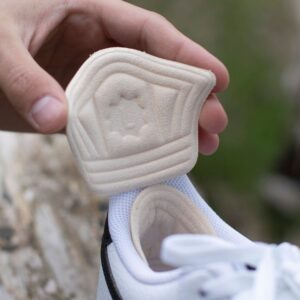
If the shoe fits well everywhere else but slips slightly at the heel, a soft heel grip can help fill some of the extra space at the back.
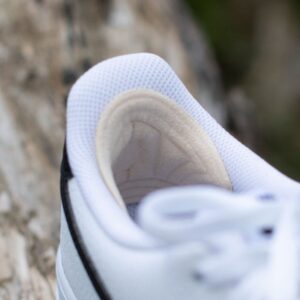
The heel grip attaches to the inside of the shoe. By giving the foot less room to move, it can help the shoe feel more secure and comfortable. Its soft surface can also feel pleasant against the heel.
And this may be the most important detail:
You do not have to use a heel grip in both shoes.
If one shoe fits well and the other slips, you can place a grip only in the shoe worn on the smaller foot. This allows you to adapt the shoes to your feet instead of expecting both feet to be exactly alike.
Our self-adhesive heel grips for shoes that slip are available in two thicknesses. The 5 mm version is primarily for a softer, more comfortable feel at the back of the shoe, while the 7.5 mm version provides more filling when the heel moves.
Your shoe size is a starting point, not a rule
The next time someone asks your shoe size, the answer may not be quite as simple as ‘8’.
The size helps you find roughly the right shoe, but its shape and how it feels on your feet determine whether it actually fits.
If one shoe slips at the heel, you do not necessarily have to give up on a pair that fits well otherwise. Sometimes all that is needed is a small adjustment – and perhaps only in one shoe.
You are not a shoe size. You have two feet that need to fit into two shoes.
 Black
Black White
White